Whether you need to register your child's birth in China, apply for Chinese nationality, or support an immigration or visa application abroad, your Singapore birth certificate is often a key document. This guide explains whether you need notarization or a direct apostille, what documents to prepare, and how the process works.
1. Notarization or Direct Apostille — Which Do You Need?
This is the most common source of confusion. A Singapore birth certificate is a government-issued document, which means it can proceed directly to apostille without notarization. However, notarization is required in the following situations:
Direct Apostille
Certifying the birth certificate only, with no translation attached, as a single standalone document. New-format certificates (with QR code) can be submitted as a PDF — no printing needed. Old-format certificates require the original paper copy.
Simplest caseFaster & cheaperNotarization + Apostille
Required when attaching a translation, combining multiple documents into one set, or submitting a photocopy rather than the original
Most commonWith translationChina no longer requires embassy legalization: China joined the Hague Apostille Convention at the end of 2023. A Singapore birth certificate with apostille can now be used directly in China — no further legalization at the Chinese Embassy is needed. If a Chinese authority still requests embassy legalization, you can present the official notice issued by the Chinese Embassy in Singapore.
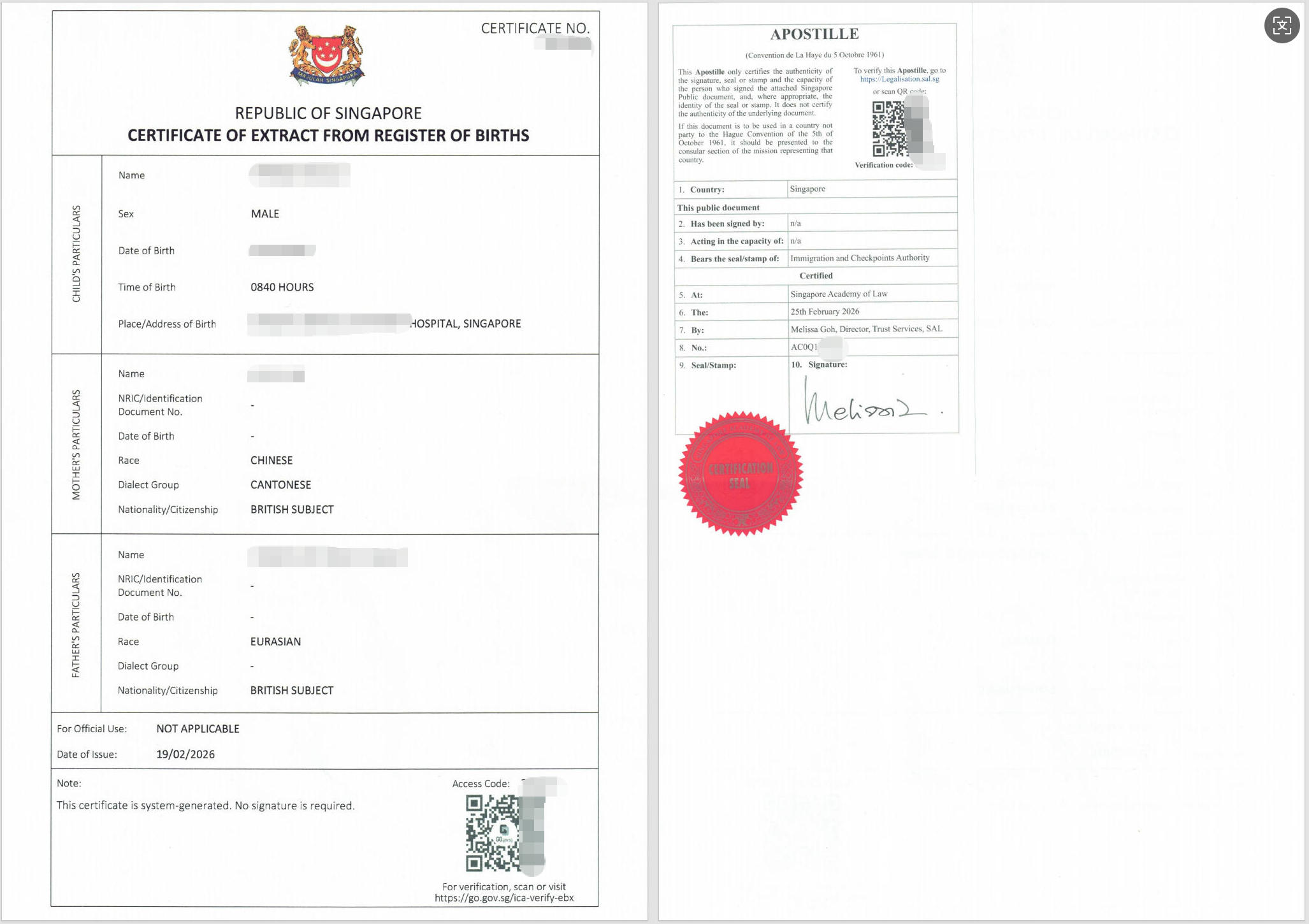
Singapore birth certificate after apostille certification (example)
2. Step-by-Step Process
Submit birth certificate (original or PDF)
→
Lervice reviews your documents
→
Notarization by lawyer (if required)
→
Apostille application
→
Collect or courier delivery
3. Documents Required
Case A: Apostille only (no translation)
- New-format birth certificate (with QR code): PDF file is sufficient, no printing required
- Old-format birth certificate (without QR code): original paper copy required
Case B: Notarization + Apostille (with Chinese translation)
- Birth certificate original or PDF (same requirements as above)
- Certificate holder's passport or Singapore NRIC/FIN
- If the certificate holder is a minor, identity documents of one or both parents are required
Case C: For countries not in the Hague Convention (embassy legalization required)
- Same documents as Case B
- Please inform us of the destination country so we can advise on the specific embassy requirements
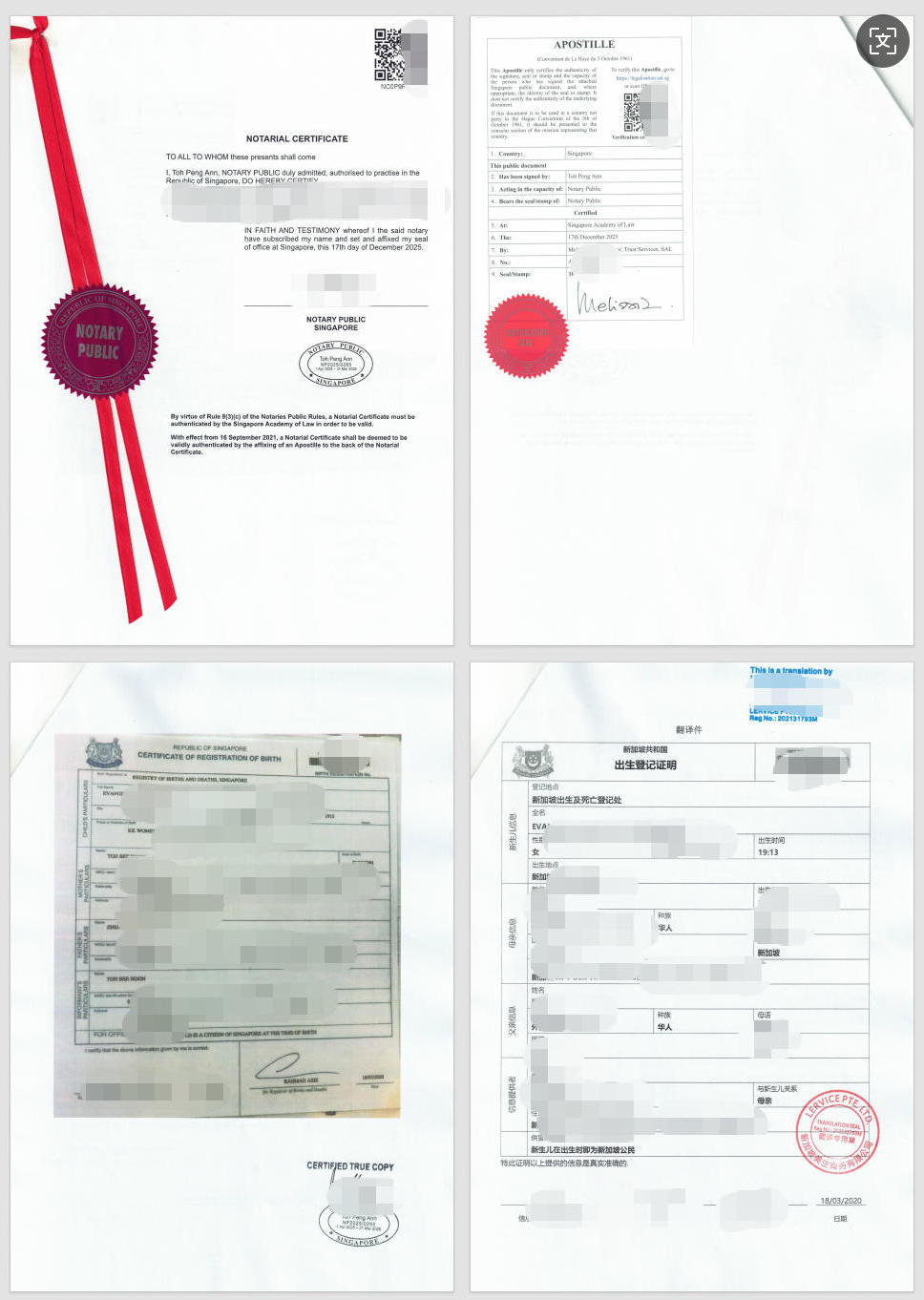
Completed birth certificate notarization and apostille package (notarization + apostille certificate)
4. Timeline
Apostille only
2
business days
Notarization + Apostille
2–3
business days
With embassy legalization
+3
additional business days
Lervice offers standardized, transparent pricing — no hourly legal consultation fees. Contact us for a quote.
5. Frequently Asked Questions
1. The birth certificate is in English — do I need a Chinese translation?
It depends on what the receiving authority requires. There are two common approaches:
Option 1 (most commonly required by Chinese authorities): The English birth certificate is notarized and apostilled first. The entire notarization booklet is then translated into Chinese. You receive two documents — the original English notarization and a Chinese translation.
Option 2: The Chinese translation is included inside the same notarization booklet as the English original. Both language versions are bound together and apostilled as one set.
We recommend confirming with the receiving authority which format they require before proceeding.
2. Does a parent need to be present to sign anything?
No. Neither the certificate holder nor parents need to be present in person. Simply submit the required documents to us and we handle the rest.
3. Can I get copies of the notarized document?
No. Singapore notarizations are issued as originals only — no certified copies are produced. If you need multiple sets, each must be ordered and paid for separately. We recommend confirming the number of sets you need before placing your order.
4. I have two children's birth certificates — can they be notarized together?
If both certificates only need to be certified as true copies, they can be combined into one notarization and apostille. However, if embassy legalization is also required, some embassies do not accept combined documents. Please let us know in advance so we can advise accordingly.
5. How long is the notarization valid? Will Chinese authorities require a "within 6 months" certificate?
The notarization itself has no expiry date, but many receiving authorities (such as household registration offices in China) require documents issued within the past 6 or 12 months. We recommend checking the time requirement with the relevant authority before placing your order to avoid having to redo it.
6. I'm overseas — can I handle this remotely?
Yes. You can courier the original birth certificate to our Singapore office. Once completed, we will courier the certified documents back to you. No in-person visit is required at any stage.
6. When Is Birth Certificate Certification Required?
Here are the most common situations that require a certified Singapore birth certificate:
Not sure which option applies to your situation?
Contact our team, tell us how the document will be used, and we'll advise the right approach for you.