Singapore Academic Certificate & Transcript Notarization and Apostille: Complete Guide
Whether you are applying for a job overseas, pursuing immigration or permanent residency, or enrolling in further education abroad, your Singapore academic certificates and transcripts will often need to be notarized and apostilled before foreign institutions will accept them. This guide explains whether your institution qualifies for direct apostille or requires notarization first, and what the process looks like for China-issued certificates used in Singapore.
1. Direct Apostille or Notarization First — Which Do You Need?
Certificates and transcripts issued by Singapore government institutions can proceed directly to apostille without notarization. All other situations require notarization before apostille.
Institutions Eligible for Direct Apostille
Certificates and transcripts from the following Singapore government and government-aided institutions can be apostilled directly upon submission of the original:
Important: degree certificates and transcripts must be processed separately. Even when issued by the same institution, a degree certificate and a transcript are two independent documents. Each must be submitted separately and processed as its own apostille order — they cannot be combined into one.
When Notarization Is Required Before Apostille
- Your institution is not on the list above (e.g. private institutions, overseas university branch campuses)
- A translation needs to be certified alongside the original document
- You are submitting a copy rather than the original
- You need the degree certificate and transcript combined in a single certified document
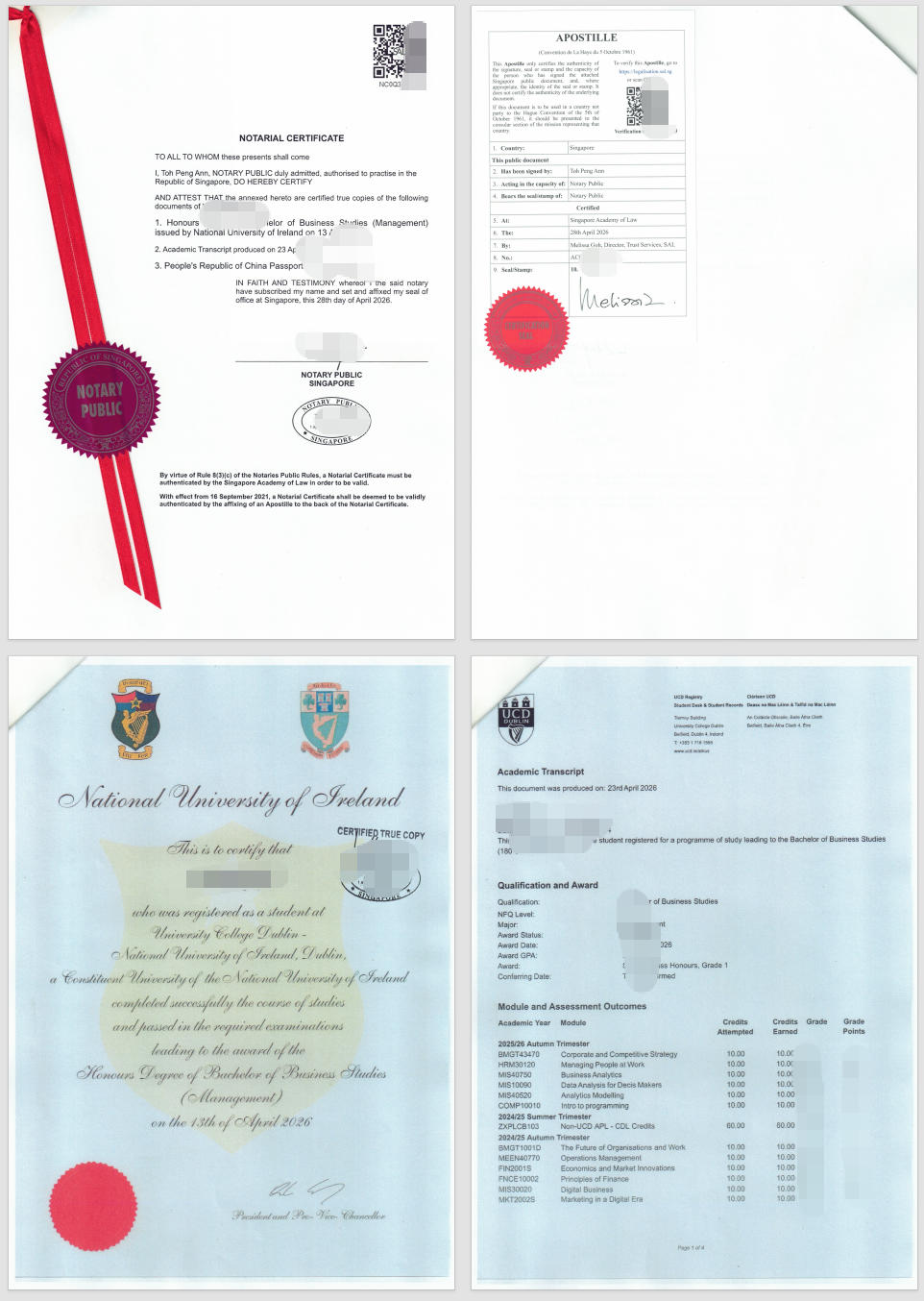
Singapore academic certificate after apostille certification (example)
2. China Academic Certificates for Use in Singapore
Academic certificates issued by institutions in China are treated as foreign documents in Singapore. MOM and other Singapore authorities cannot independently verify their authenticity. Regardless of the institution's ranking or prestige, China-issued academic certificates used in Singapore always require notarization, apostille, and an English translation.
Common situations include submitting to MOM for an Employment Pass (EP), S Pass, or other work pass application, and proving educational background for Dependent Pass (DP) or Long-Term Visit Pass (LTVP) applications.
How is the translation handled? The Chinese original and its English translation are bound together in the same notarization booklet. After notarization and apostille, the document submitted to Singapore authorities contains both the Chinese original and the certified English translation in one complete package. Lervice provides the English translation — no separate arrangement is needed.
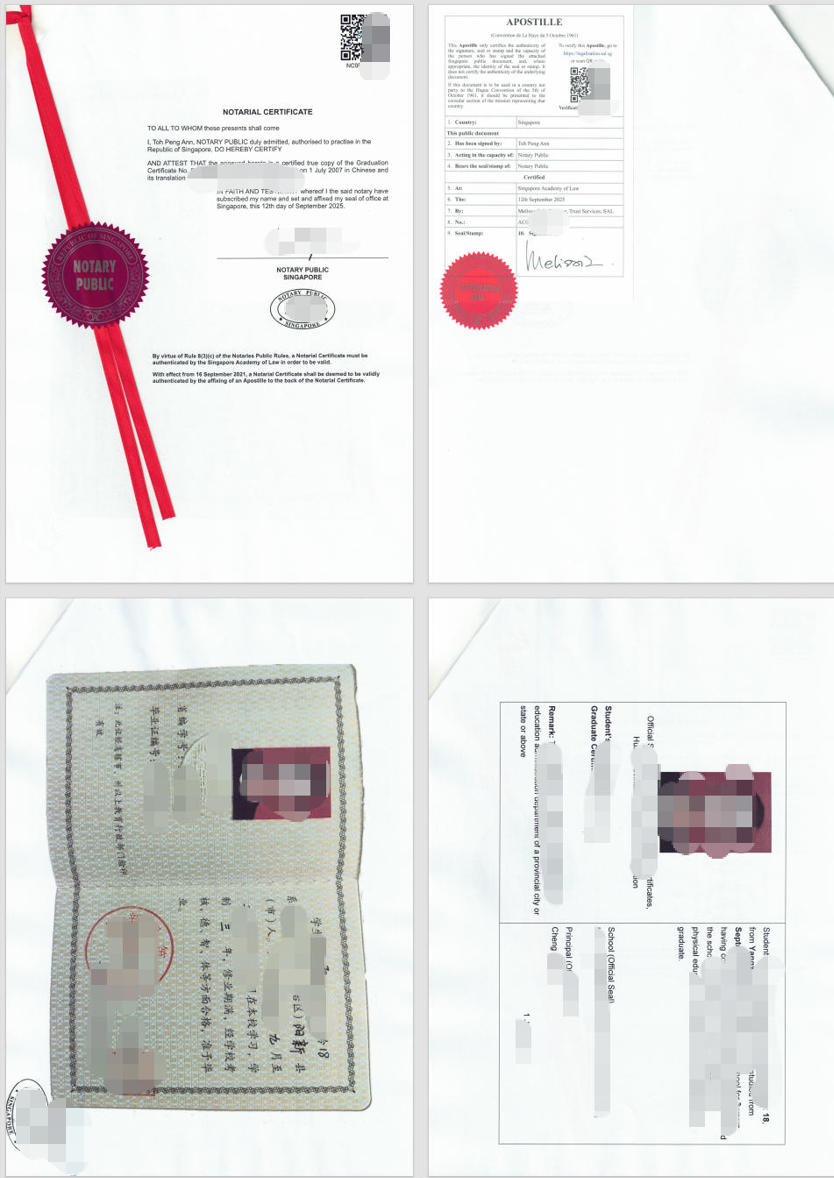
China academic certificate after translation, notarization, and apostille — complete bilingual document package (example)
3. Step-by-Step Process
Submit certificate / transcript
→
Lervice reviews your documents
→
Notarization by lawyer (if required)
→
Apostille application
→
Collect or courier delivery
4. Documents Required
Case A: Singapore government institution — Direct Apostille
- Degree certificate original
- Transcript original
- Note: each document must be submitted separately and processed as an independent order
Case B: Other institutions or with translation — Notarization + Apostille
- Degree certificate original or clear scan
- Transcript original or clear scan
- Applicant's passport or Singapore NRIC/FIN
- If a translation is required, please advise the target language and destination country
Case C: China academic certificate for use in Singapore — Notarization + Translation + Apostille
- China degree certificate original or clear scan
- China transcript original or clear scan (if certification is required)
- Applicant's passport original or clear scan
Case D: For countries not in the Hague Convention (embassy legalization required)
- Same documents as the relevant case above
- Please inform us of the destination country so we can advise on the specific embassy requirements
5. Timeline
Direct apostille
2
business days
Notarization + Apostille
2–3
business days
With embassy legalization
+3
additional business days
Lervice offers standardized, transparent pricing — no hourly legal consultation fees. Contact us directly for a quote.
6. Frequently Asked Questions
1. Can my degree certificate and transcript be certified together in one document?
It depends on the method. If you choose direct apostille, both documents must be submitted separately and processed as independent orders. If you choose notarization followed by apostille, both can be bound together in a single notarization booklet and apostilled together — saving time and cost.
2. My institution is not on the list — do I have to notarize first?
Yes. Only certificates from the Singapore government institutions listed above can proceed directly to apostille. All other institutions — including private schools, overseas university branch campuses in Singapore, and so on — require notarization by a lawyer before the apostille can be applied.
3. Will my originals be returned to me?
Yes — your originals are always returned untouched. For direct apostille, the apostille sticker is attached to the back of a copy of the document, not the original itself. For notarization, copies are bound into the notarization booklet while the originals are returned to you separately. In neither case are your originals retained or used.
4. Can I get copies of the notarized document?
No. Singapore notarizations are issued as originals only — no certified copies are produced. If you need multiple sets, each must be ordered and paid for separately. We recommend confirming the number of sets you need before placing your order.
5. How long is the certification valid? Will authorities require a "recent" apostille?
The notarization itself has no expiry date, but some receiving authorities require documents issued within a certain period. We recommend checking the time requirement with the relevant authority before placing your order to avoid having to redo it.
6. I'm not in Singapore — can I handle this remotely?
Yes. You can courier your original certificates to our Singapore office. Once the process is complete, we will courier everything back to your address. No in-person visit is needed at any stage.
7. When Is Academic Certificate Certification Required?
Here are the most common situations that require certified academic certificates or transcripts:
Not sure whether your institution qualifies for direct apostille?
Contact our team, tell us your institution and purpose, and we'll confirm the right approach for you.