Singapore Divorce Judgment Notarization & Apostille: Final Judgment & Interim Judgment Complete Guide
A divorce judgment issued by the Singapore courts is the legal document that proves a marriage has been formally dissolved. When registering for remarriage, applying for a visa, pursuing immigration, or fulfilling any other requirement to prove marital status abroad, foreign authorities will typically require the judgment to be notarized and apostilled before accepting it. This guide explains the process, the difference between an Interim Judgment and a Final Judgment, and everything you need to prepare.
1. Interim Judgment vs Final Judgment — Which One Do You Need?
Singapore's divorce process takes place in two stages, producing two separate court orders:
Interim Judgment of Divorce
Issued at the first stage of proceedings. It declares the marriage dissolved but does not yet resolve ancillary matters such as child custody and asset division. Some authorities accept this as proof of divorce.
First-stage orderAccepted by some authoritiesFinal Judgment of Divorce
Issued once all proceedings are concluded and all ancillary matters have been resolved. This is the most complete and authoritative proof of divorce, and is required by the vast majority of authorities.
Final orderMost commonly requiredBoth documents can be combined in one notarization: If you need to certify both the Interim Judgment and the Final Judgment, choosing notarization allows both to be bound together in a single notarization booklet and apostilled together — saving time and cost. If you choose direct apostille (without notarization), each document must be submitted separately and processed as two independent orders.
2. Direct Apostille or Notarization First — Which Do You Need?
Singapore court-issued divorce judgments are government documents, which means they can proceed directly to apostille without notarization. However, notarization is required in the following situations:
Direct Apostille
Certifying the judgment only, with no translation attached, and each document submitted separately. Interim Judgment and Final Judgment are processed as two independent orders.
Simplest caseFaster & cheaperNotarization + Apostille
Required when attaching a translation; or when combining both judgments into one certified document; or when submitting a copy rather than the original
With translationCombining both documentsChina no longer requires embassy legalization: China joined the Hague Apostille Convention at the end of 2023. A Singapore divorce judgment with apostille can now be used directly in China — no further legalization at the Chinese Embassy is required. If a Chinese authority still requests embassy legalization, you can present the official notice issued by the Chinese Embassy in Singapore.
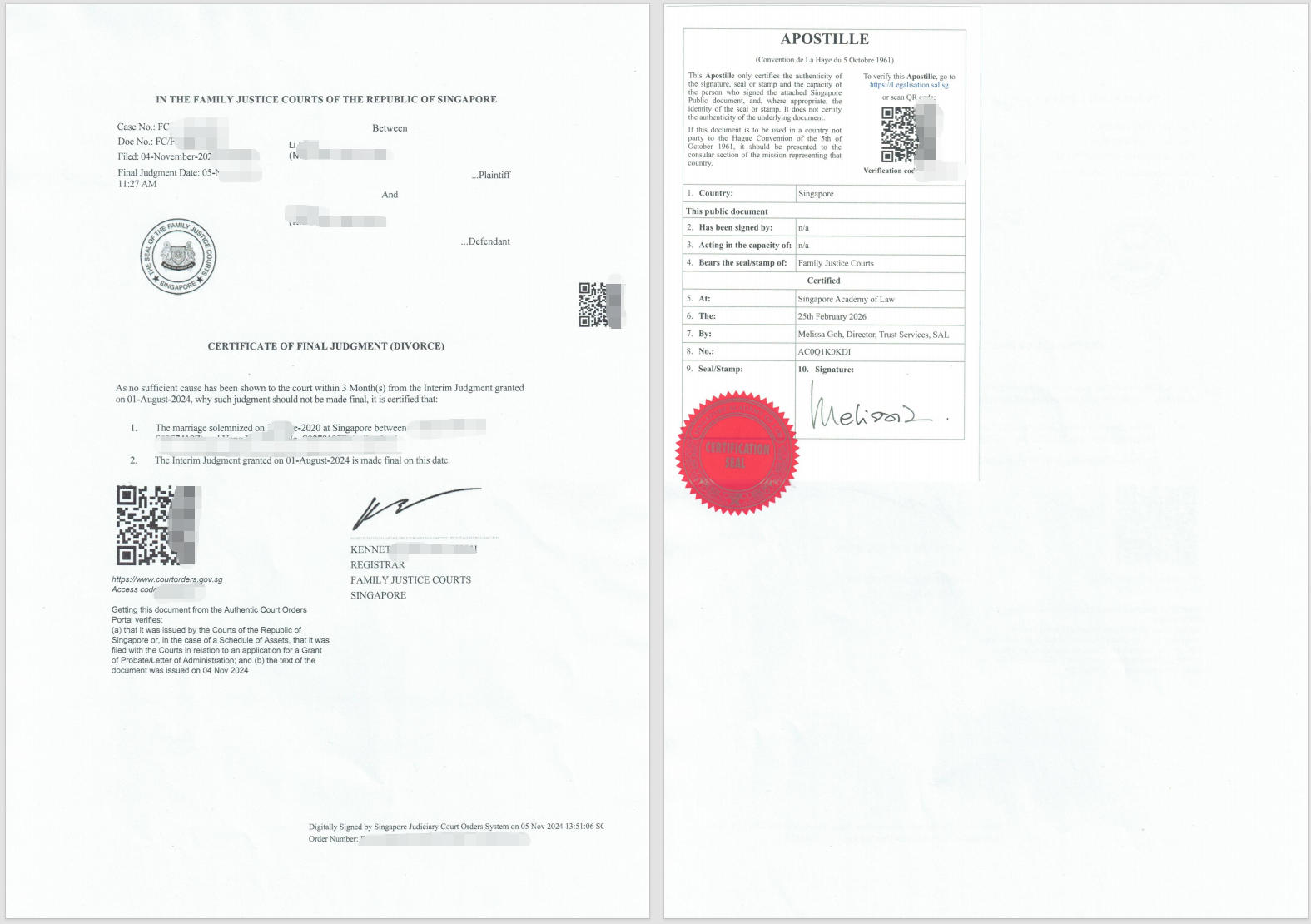
Singapore divorce judgment after apostille (example)
3. Step-by-Step Process
Submit judgment PDF
→
Lervice reviews your documents
→
Notarization by lawyer (if required)
→
Apostille application
→
Collect or courier delivery
4. Documents Required
Case A: Direct apostille only (no translation)
- PDF of Interim Judgment and/or Final Judgment (Singapore court divorce judgments are issued electronically — no paper original is required)
- Note: each document must be submitted separately and will be processed as an independent order
Case B: Notarization + Apostille (with translation, or combining both documents)
- PDF of Interim Judgment and/or Final Judgment
- Applicant's passport or Singapore NRIC/FIN
- If a translation is required, please let us know the destination country so we can advise on the translation requirements
Case C: For countries not in the Hague Convention (embassy legalization required)
- Same documents as Case B
- Please inform us of the destination country so we can advise on the specific embassy requirements
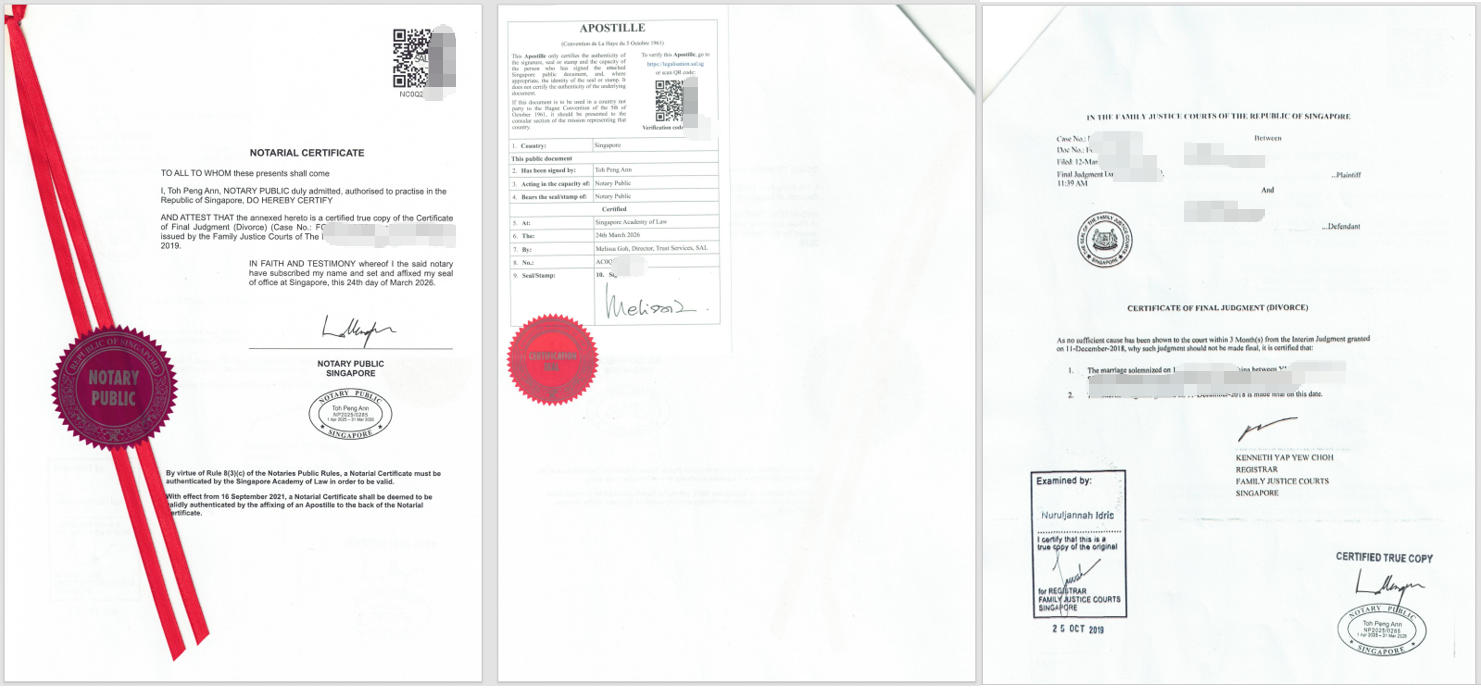
Interim Judgment and Final Judgment combined and notarized as one document package (example)
5. Timeline
Direct apostille
2
business days
Notarization + Apostille
2–3
business days
With embassy legalization
+3
additional business days
Lervice offers standardized, transparent pricing — no hourly legal consultation fees. Contact us directly for a quote.
6. Frequently Asked Questions
1. I only have the Interim Judgment, not the Final Judgment — can I still proceed?
Yes. Some authorities accept the Interim Judgment as proof of divorce, and we can notarize and apostille it on its own. We recommend confirming with the receiving authority which document they require before proceeding, to avoid having to redo it. If both are needed, combining them in a single notarization is the more cost-effective option.
2. Does the divorce judgment need to be translated?
It depends on the requirements of the receiving authority. If a translation is required, the standard approach is to translate the entire notarization booklet into the target language, producing a separate translated document. For use in China, the receiving authority specifically requires translations to be produced by a qualified translation agency based in China. Requirements for other countries vary — we recommend confirming with the authority before proceeding. Contact us with the destination country and we will advise the most appropriate approach.
3. Do I need to appear in person?
No. Singapore divorce judgments are issued as electronic documents. Simply send us the PDF — no in-person visit or paper documents are required at any stage.
4. Can I get copies of the notarized document?
No. Singapore notarizations are issued as originals only — no certified copies are produced. If you need multiple sets, each must be ordered and paid for separately. We recommend confirming the number of sets you need before placing your order.
5. How long is the notarization valid? Will authorities require a document issued "within 6 months"?
The notarization itself has no expiry date, but many receiving authorities require documents issued within the past 6 or 12 months. We recommend confirming the time requirement with the relevant authority before placing your order to avoid having to redo it.
6. I'm not in Singapore — can I handle this remotely?
Yes. Since the divorce judgment is an electronic document, simply email us the PDF — no courier or paper originals needed at all. Once complete, we will courier the certified documents to your address.
7. When Is Divorce Judgment Certification Required?
Here are the most common situations that require a certified Singapore divorce judgment:
Not sure which process applies to your situation?
Contact our team, describe your needs, and we'll advise the right approach for you.